
How to Check Criminal History in Matador
Begin a Matador search by naming the record, not just the person. An incident narrative, an arrest report, a booking sheet, a filed case, and a DPS history are separate products. Matador has no verified city police portal, booking log, or court lookup. The available Matador path moves from the Motley County Sheriff to the correct county court office, then to a state system only when the Matador question calls for it. This order helps avoid mistaking a city service page for a criminal-record channel.
- Call the Motley County Sheriff about a Matador incident, arrest, warrant, or the current holding location.
- Describe the Matador event by date, place, agency, report number, and record type. Ask how to make a formal public-information request.
- Ask the countywide Justice Court about qualifying fine-only or traffic matters. Do not treat online payment as proof of status.
- Use the combined clerk for a filed Matador county or district case, including its docket, judgment, and disposition.
- Use the DPS public name search for eligible statewide convictions and deferred adjudications, or FAST fingerprints to review your own record.
A no-result answer from one Matador step does not settle the whole Matador record check. A recent arrest may not yet have reached the clerk, while an old court file may say nothing about present custody. Confirm the event and its outcome with the Matador offices that created those parts.
Matador Records on Dundee Avenue
Matador City Hall and the Motley County Courthouse stand close together, but they serve different record roles. City Hall is at 706 Dundee Avenue. The courthouse and combined clerk are at 701 Dundee Avenue, also styled by the county as 701 Main and Dundee. City Hall handles municipal administration. The Matador clerk preserves county and district court filings. A short Matador walk does not make the offices interchangeable.
The official Matador contact page shows City Hall hours and helps a visitor confirm the municipal counter before a trip.
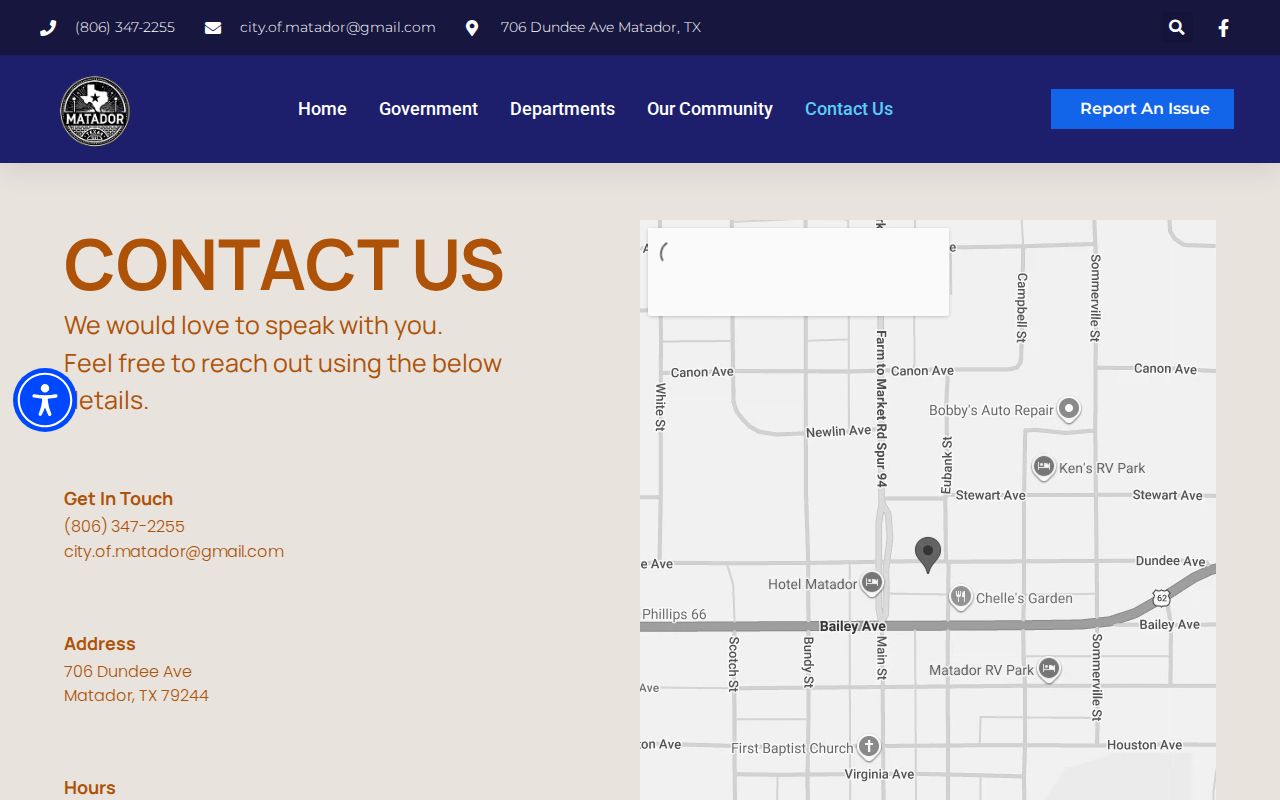
The screen supplies Matador city contact context, while criminal reports and court records still route to the sheriff, justice court, or combined clerk. Matador City Hall is open Monday through Thursday from 8 a.m. to noon and 1 to 5 p.m., and Friday from 8 a.m. to noon. Clerk hours differ: weekdays from 9 a.m. to noon and 1 to 5 p.m. Calling first matters on Friday and around the noon closure.
The Matador Police Department
No Matador police department, police records unit, blotter, app, or municipal records portal appears in the official city department list, the DPS NIBRS-approved roster, or the current OCA municipal-court directory. That is a documented routing gap, not proof that no special arrangement could ever exist. The supported first contact for a Matador law-enforcement record is the Motley County Sheriff at 806-347-2234, PO Box 715, Matador, TX 79244, or fax 806-347-2692.
The sheriff web form used for Matador questions asks for a name, telephone number, email, confirmed email, reason for inquiry, and reCAPTCHA. It is a general Matador inquiry form. It is not labeled as formal Texas Public Information Act intake. A Matador requester should ask whether the form, fax, or signed mailed letter is the accepted method for the desired Matador record. The sheriff page does not publish a physical lobby, set records hours, copy fee, or local clearance product, so those points need telephone confirmation.
Motley County Sheriff
PO Box 715
Matador, TX 79244
806-347-2234
Fax: 806-347-2692
Physical records counter and hours are not published.
Matador Forms That Do Not Fit
The Matador Document Center is a city file library, but research found no criminal-report request there. Its presence can still be useful because it shows where city documents may be posted and where they are not. Do not assume a city archive contains a sheriff report, booking event, or court judgment simply because those records concern conduct inside Matador. The Matador Document Center provides the clearest official view of that municipal resource.
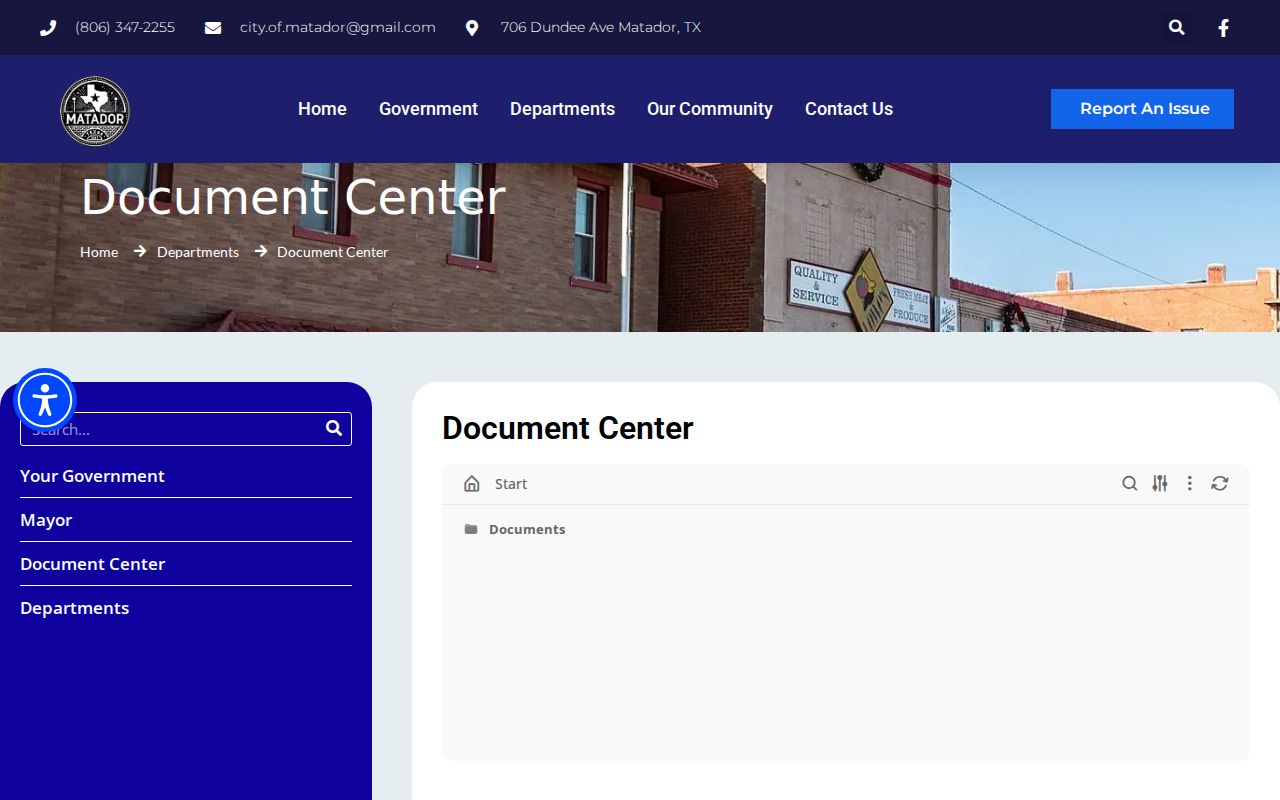
This interface belongs to Matador city administration, not the sheriff or the court clerk. The same limit applies to the city report-an-issue form. Its service categories include plumbing, landscaping, roofing, and repair, along with a preferred date, priority, instructions, and an attachment. Those fields describe a Matador service request. The official Matador report-an-issue page makes the service purpose plain.
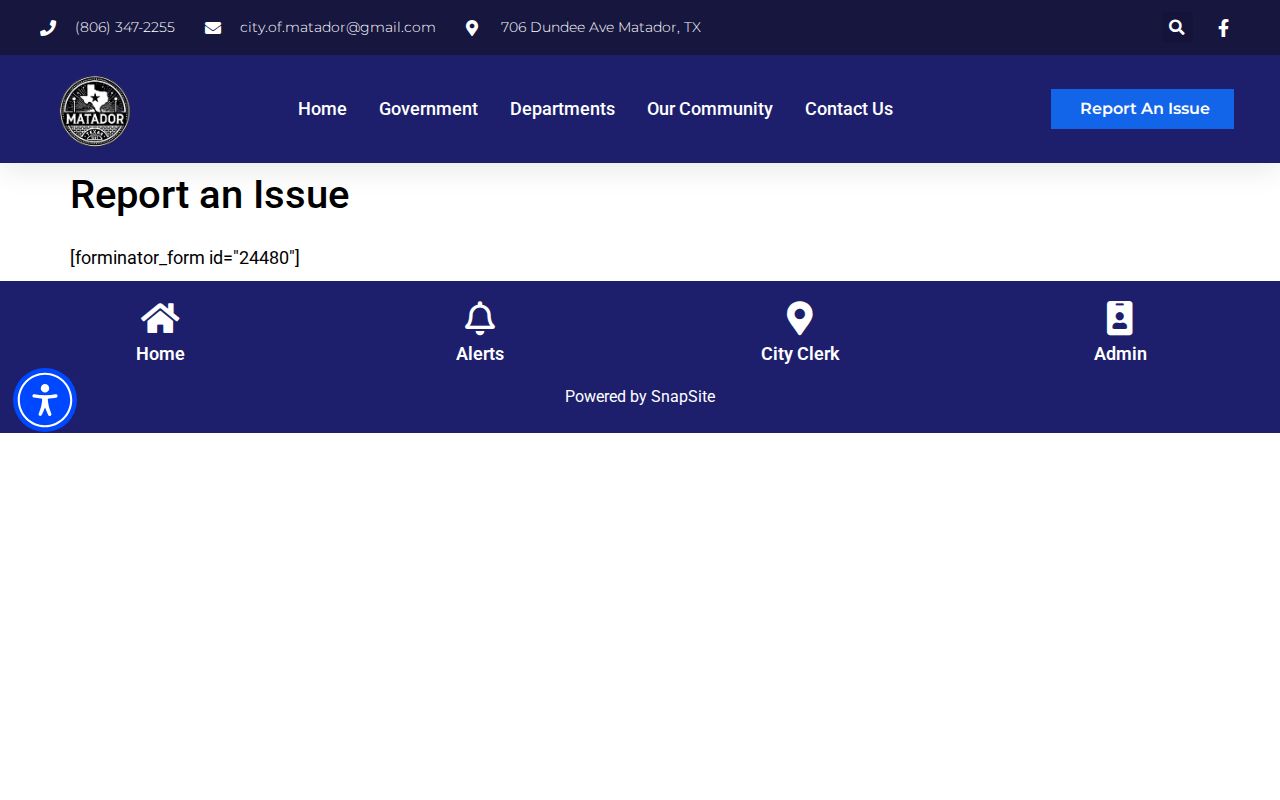
Sending a Matador criminal-record request through that page risks delay because it is not identified as a police, court, or public-information form. Use the Matador record holder instead.
Arrests and Bookings in Matador
Matador has no documented city jail, arrest blotter, booking log, roster, or mugshot portal. For a recent Matador arrest, call the sheriff and ask two separate questions: which agency made the arrest, and which facility accepted the person. For that Matador event, the arresting agency keeps its incident narrative. The Matador receiving facility creates the booking and custody record. Those may be different offices, especially if a DPS trooper made the arrest or a facility outside Motley County accepted the person.
Ask for the Matador arrest or booking date, actual holding facility, direct facility number, booking identifier, intake charges, bond, magistrate, and release or transfer status. Once the location is known, use that facility's official rules for calls, visits, mail, and deposits. Do not travel to the 1891 historic jail. It is a Matador heritage site, not a confirmed working detention facility. The full county access chain is developed further on the Motley County arrest history page.
Charges in a Matador booking are allegations. They may be changed, rejected, reduced, or dismissed when a prosecutor reviews the event. A Matador booking record therefore cannot prove guilt or give the final outcome.
Matador Jail History Versus Records
The old Motley County Jail offers rich Matador history but poor modern booking guidance. Built in 1891, the year the county organized, it placed cells upstairs and the jailer's living quarters below. It survived the fire that destroyed the first courthouse and became a Recorded Texas Historic Landmark in 1976. The Matador site also carries Quanah Parker associations documented by the Texas Historical Commission.
That Matador history helps explain why an old structure may appear in a Matador image search. It does not identify today's holding facility. A person seeking a recent Matador custody record should call the sheriff, learn where the arrested person was taken, and then contact that facility. Heritage facts and current justice access must stay apart.
Note: A photograph of a historic jail is not evidence that the building now accepts detainees, visitors, mail, funds, or record requests.
Matador Municipal Court Records
The current Office of Court Administration municipal-court directory has no Matador entry. Eligible fine-only and traffic matters instead route through Motley's countywide Justice Court, subject to confirmation with that office. The justice court publishes morning-only weekday hours and a payment link, but payment access is not a complete case lookup and does not establish that a warrant has cleared.
| Court Name | Motley Countywide Justice Court; no Matador municipal court is listed in the current OCA directory |
|---|---|
| Case Types Heard | Qualifying fine-only, traffic, and justice-court matters |
| Case Lookup Channel | Call 806-347-2204 or contact the court by mail at PO Box 657, Matador, TX 79244 |
| What to Request | Case or cause number, charge, docket status, disposition, fine, and any related capias information |
| Copies and Fees | No Matador municipal schedule applies; confirm justice-court access and costs directly |
Matador felony filings belong at the 110th District Court level, and ordinary Class A or B misdemeanor matters go to the constitutional County Court. The combined County and District Clerk in Matador maintains those filed records. This Matador court split is why a justice-court answer should not be read as a search of every Matador criminal case.
Matador Crime Data Has County Scope
The official NIBRS-approved agency roster lists Motley County Sheriff as the county reporting agency. It does not list a Matador police agency. As a result, an official county total cannot be relabeled as a Matador-only crime rate. The reporting agency's geographic scope and the place named in an incident are different facts. The DPS approved-agency roster documents the local reporting arrangement.
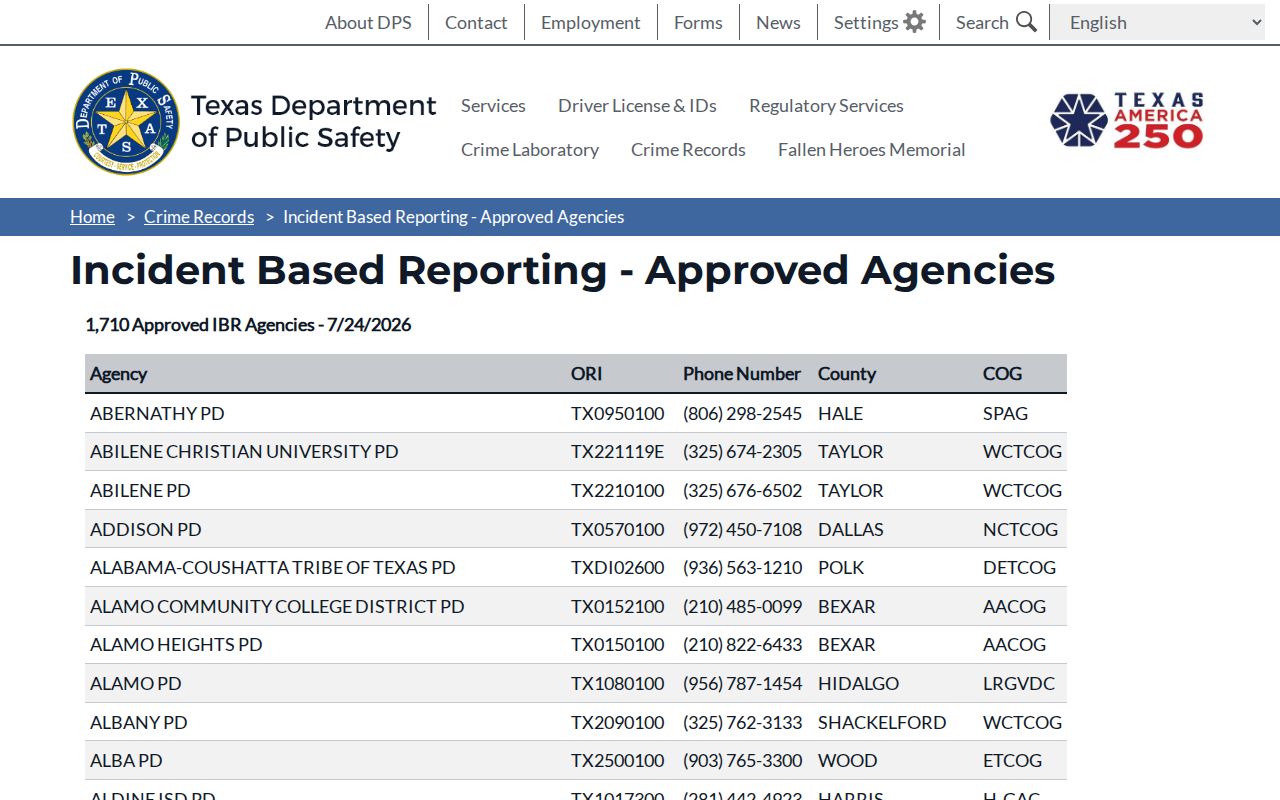
The roster supports sheriff-level routing but does not provide a Matador arrest log. DPS describes how Texas agencies submit incident-based data through the Uniform Crime Reporting program. The official NIBRS and UCR overview explains that framework.
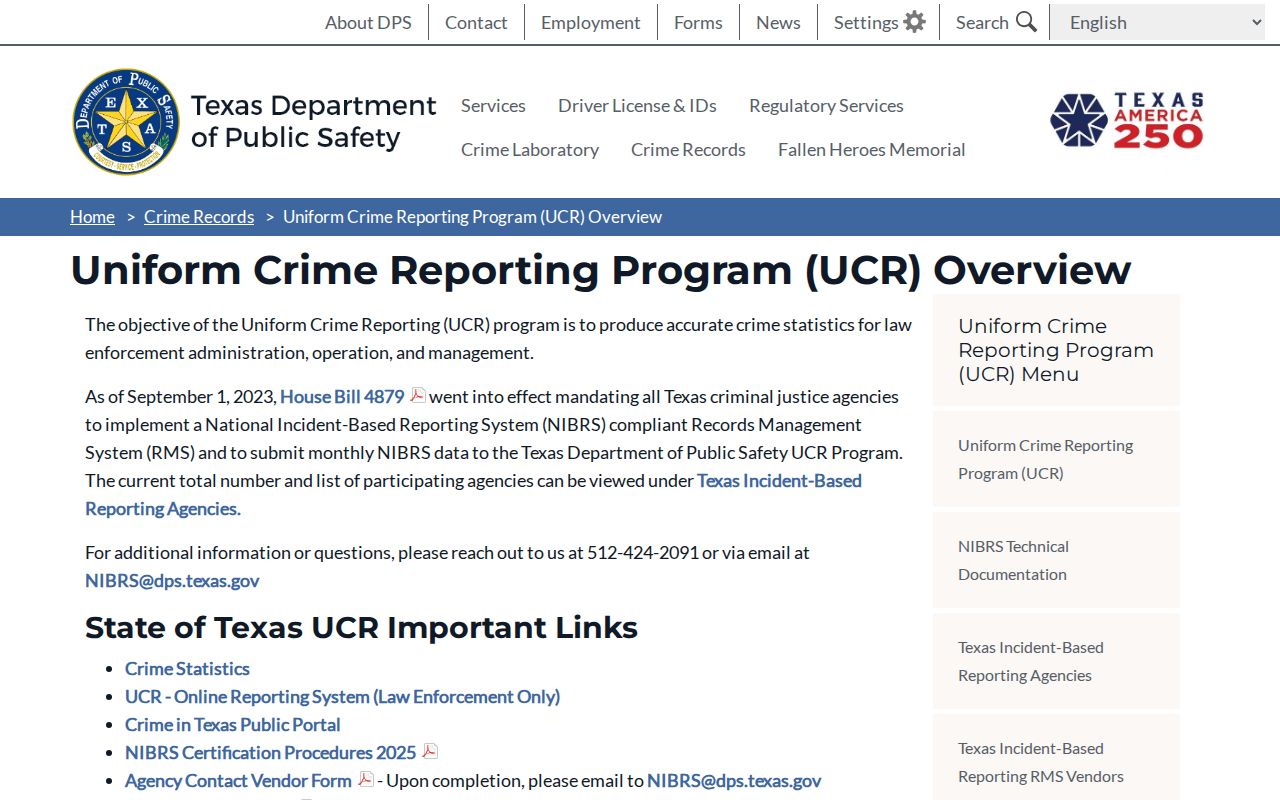
This second interface explains reporting, not individual Matador records. Use a Matador sheriff request for an incident and the clerk for a filed case rather than trying to identify a person through aggregate statistics.
Where Matador Records End Up
A Matador event can create several linked records. The sheriff or other arresting agency writes the incident and arrest report. A holding facility makes the booking file. A prosecutor creates the complaint, information, or proposed indictment. The combined clerk keeps the court case after filing. For a reportable arrest, fingerprint and tracking data go to the Texas Department of Public Safety, and the court later reports the disposition.
Record flow: Matador incident › Motley County Sheriff or arresting agency › Motley County courts › Texas Department of Public Safety
Each point answers a different Matador criminal-history question. The first agency has the event narrative. The holding facility has custody facts. The clerk has the filed charge and outcome. DPS maintains fingerprint-linked statewide criminal history and provides a narrower public name-search product for eligible convictions and deferred adjudications. Names alone can over-match or miss a record, so fingerprints are the sound route for reviewing your own Texas history.
Matador Court Records Since 2003
The combined clerk directs readers to iDocket for public records recorded since 2003. The service requires a subscription login and is not a free universal Matador court search. Plan-dependent tools may support a party name or state and cause number, calendar details, image purchases, and reminders. The research could not inspect Motley-specific criminal result columns behind the account gate, so no status field or document view should be promised.
Use the clerk fallback when a Matador case predates 2003, a result is missing, an image is unavailable, or an official disposition and certified copy are needed. Taylor Elliott's combined office is at 701 Dundee Avenue, telephone 806-347-2621, with weekday hours of 9 a.m. to noon and 1 to 5 p.m. Ask the fee before ordering because no criminal-copy schedule was found in the official sources.
A Matador requester should seek the cause number, filing date, court, charging instrument, docket events, plea, judgment, sentence, and any later order. These are request targets, not a claim that each item appears in the subscription interface.
Public Access Rules
The record holder controls the access path. Sheriff-created Matador reports fall under the Texas Public Information Act, but active investigations, juvenile records, victim data, and other confidential material may be withheld or redacted. Filed adjudicative case records go to the clerk under court-access rules. Texas courts are not simply governed by the Public Information Act in the same way as an executive agency.
Key Statutes:
Texas Government Code Chapter 552 gives access to nonexcepted governmental public information.
Texas Government Code Sections 411.083 and 411.135 restrict criminal-history data while permitting public conviction and deferred-adjudication access.
Texas Rule of Judicial Administration 12 guidance explains the separate treatment of court administrative records and adjudicative case files.
Code of Criminal Procedure Chapter 55A governs expunction of qualifying arrest records.
A narrowly framed Matador request should state the event date, place, agency, known report or cause number, and exact material sought. A public-information letter does not override a statute that makes data confidential. An order of nondisclosure restricts general public release without destroying the record, while expunction is a separate remedy with its own eligibility rules.
Plan a Matador Records Visit
Matador's small scale can make the offices look easy to reach, yet split hours and missing online tools raise the cost of a failed trip. Confirm the correct office, open counter, record location, request method, identification rule, copy cost, and pickup plan before driving. The courthouse closes at noon and reopens in the afternoon. The justice court publishes mornings only. City Hall keeps a half day on Friday.
Call the sheriff before seeking any Matador custody location because no current jail facility is published. Call the clerk for older or authoritative court material. Call the justice court for eligible fine-only matters. If a warrant question is involved, confirm the issuing court and current status instead of relying on a payment page or a stale copy. Do not make a surprise surrender plan without first confirming the court, counsel, bond, and location.
Note: Matador offices do not publish full parking, entry-screening, accessibility, recording, or interpreter instructions, so ask about needed arrangements by phone.