
How to Check Criminal History in Roaring Springs
First decide whether the Roaring Springs question concerns an incident, custody event, warrant, filed case, final court outcome, or statewide history. There is no verified city database that combines those items. Use the office that created the slice, then move through the county chain only as far as needed. A city event can leave records with several holders even though Roaring Springs itself publishes no criminal-record portal.
- Call the Motley County Sheriff at 806-347-2234 for a Roaring Springs incident, arrest, warrant question, or custody location.
- Give the date, place, involved agency, event type, and any report or booking number. Ask which formal request channel the sheriff accepts.
- Contact the countywide Justice Court for qualifying fine-only, traffic, failure-to-appear, or capias questions.
- Ask the combined clerk in Matador for filed county and district cases, older records, dispositions, and authoritative copies.
- Use Texas DPS for eligible public statewide conviction and deferred-adjudication data, or FAST fingerprints to review your own full Texas record.
Keep the arresting agency and holding facility separate. A trooper may create the report while another county's facility makes the booking record. The clerk receives the case only after filing, so a same-day Roaring Springs custody call can be useful before a docket appears.
Roaring Springs Records Route to Matador
Roaring Springs is the county's second and only other incorporated place, but the official justice contacts are in Matador. SH 70 connects the two towns. The combined County and District Clerk works at the Motley County Courthouse, 701 Dundee Avenue in Matador. The office takes calls at 806-347-2621 and keeps weekday hours from 9 a.m. to noon and 1 to 5 p.m. Mail goes to PO Box 660, Matador, TX 79244.
The countywide Justice Court also uses a Matador mailing address. Its number is 806-347-2204, and its published counter hours are only 9 a.m. to noon on weekdays. The sheriff uses PO Box 715 in Matador and does not publish a physical records lobby or office hours. A Roaring Springs resident should call before taking the highway, confirm where the requested file sits, and ask whether telephone, mail, fax, or an in-person visit is best.
Note: No official Roaring Springs city records telephone, address, hours, or request counter was located, so county contacts are the documented route.
The Roaring Springs Police Department
No Roaring Springs police department appears in the official DPS NIBRS-approved roster, and no city police records unit, form, portal, app, or blotter was found. This is a strong routing fact, but it should not be stretched into a claim that no special law-enforcement agreement could exist. For an incident inside Roaring Springs, the supported first call is the Motley County Sheriff. If a Texas DPS trooper created the report, the DPS records route controls that narrative.
The sheriff's online contact form collects a name, phone number, email, confirmed email, reason for inquiry, and reCAPTCHA. It is not labeled as a formal Texas Public Information Act form. A Roaring Springs requester should state the exact record category and ask how to submit the formal request. Useful details include the event date, approximate time, location, agency, involved names, and known report number. Ask about fees, redactions, delivery, and identification before sending payment or making the drive.
Motley County Sheriff
PO Box 715
Matador, TX 79244
806-347-2234
Fax: 806-347-2692
Confirm the physical counter and hours by phone.
Roaring Springs Official Local Anchor
Official county election material documents the Roaring Springs Community Center as the Precinct 4 voting site and separately recognizes city elections. That page is an honest official anchor for Roaring Springs. It does not create a criminal-record desk, police portal, or municipal court. A building named in an election notice serves the function stated in that notice.
The Motley County elections page is the source for the Roaring Springs community-center reference.
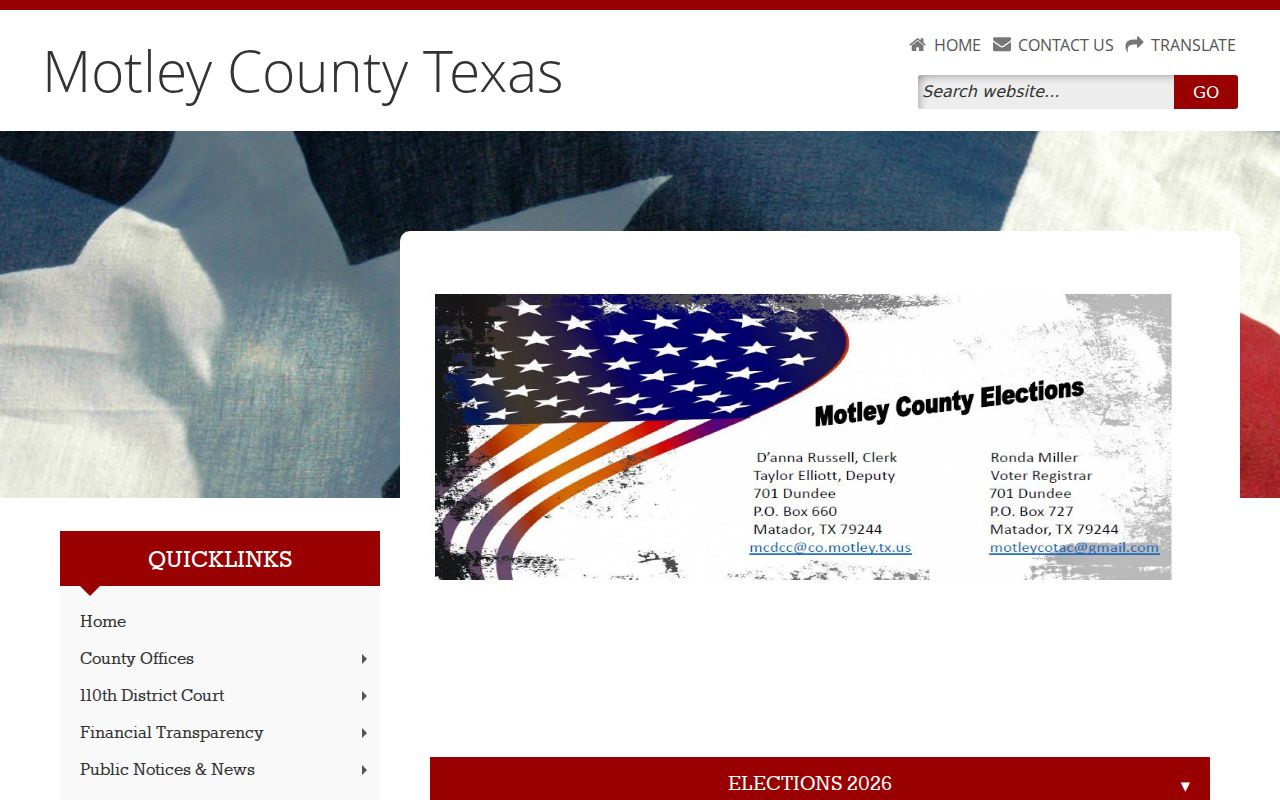
The screenshot confirms an official local place while also showing why record purpose matters. Election administration and criminal justice remain distinct. Send a Roaring Springs report request to the creating agency and a filed case request to the combined clerk, not to a voting location.
Arrests and Bookings in Roaring Springs
There is no documented Roaring Springs city jail, county booking roster, recent-arrest log, mugshot page, or sheriff app. To trace a recent Roaring Springs arrest, call the sheriff and ask which agency made the arrest and where the person was booked. Then contact the actual holding facility for the booking identifier, intake charges, bond, magistrate, custody status, transfer, or release. The county's historic 1891 jail is not a verified working facility and should never be used as current detention guidance.
An officer's report records the event and legal basis. A facility creates the intake file. A magistrate produces initial appearance or bond material. The prosecutor and clerk create the case file after charges are filed. Those events can happen at different times and in different places. A Roaring Springs arrest might be confirmed by phone while iDocket still has no cause, and that timing gap is normal.
Texas law requires magistration without needless delay, generally within 48 hours, but the hearing and the holding location need not be the same building. For the full county channel sequence, use the Motley County arrest history resource.
Roaring Springs Warrant Record Chain
No official Roaring Springs or Motley County active-warrant database, public list, most-wanted page, app tool, amnesty notice, or dedicated warrant line was found. Texas also has no complete public statewide e-warrant name search. A Roaring Springs warrant check must follow the level that may have issued or retained the record.
- Call the sheriff at 806-347-2234 about executable sheriff-held warrant information.
- Call the combined clerk at 806-347-2621 about district or county docket and capias entries.
- Call the countywide Justice Court at 806-347-2204 about qualifying fine-only, traffic, failure-to-appear, or capias-pro-fine matters.
A payment screen is not proof that a Roaring Springs warrant has cleared. Ask the issuing court for current confirmation. Sealed, juvenile, and active investigative information may not be public. Anyone addressing their own warrant should confirm the court, counsel, bond, and location before appearing rather than relying on an old notice.
Roaring Springs Municipal Court Records
The current OCA municipal-court directory has no Roaring Springs entry. The documented local route for eligible fine-only and traffic matters is the countywide Justice Court, with its morning hours and Matador mailing address. This is routing evidence rather than a promise about the jurisdiction of an unknown case. The court should confirm that it has the matter before a visitor travels.
| Court Name | Motley Countywide Justice Court; no Roaring Springs municipal court is listed |
|---|---|
| Case Types Heard | Qualifying fine-only, traffic, and justice-court matters |
| Case Lookup Channel | Telephone 806-347-2204 or mail to PO Box 657, Matador, TX 79244 |
| What to Request | Cause number, charge, docket status, disposition, fine, and related capias status |
| Copies and Fees | No Roaring Springs municipal schedule exists in the research; ask the justice court directly |
A Justice Court response is not a search of every Roaring Springs case. Felonies route to the 110th District Court. Ordinary Class A and B misdemeanor matters route through the constitutional County Court. The combined clerk maintains filings for both county and district levels in Matador.
Roaring Springs Cases Behind iDocket
The combined clerk points to iDocket for records recorded since 2003. The portal has a subscription gate. Its sign-in requires a subscriber user ID and password, while plan-dependent access may include name or state and cause-number searches, calendars, parties, images, and reminders. The research did not cross the account gate to verify Motley-specific criminal fields, result columns, disposition codes, or document availability.
The official iDocket sign-in shows the actual access barrier a Roaring Springs searcher will meet.
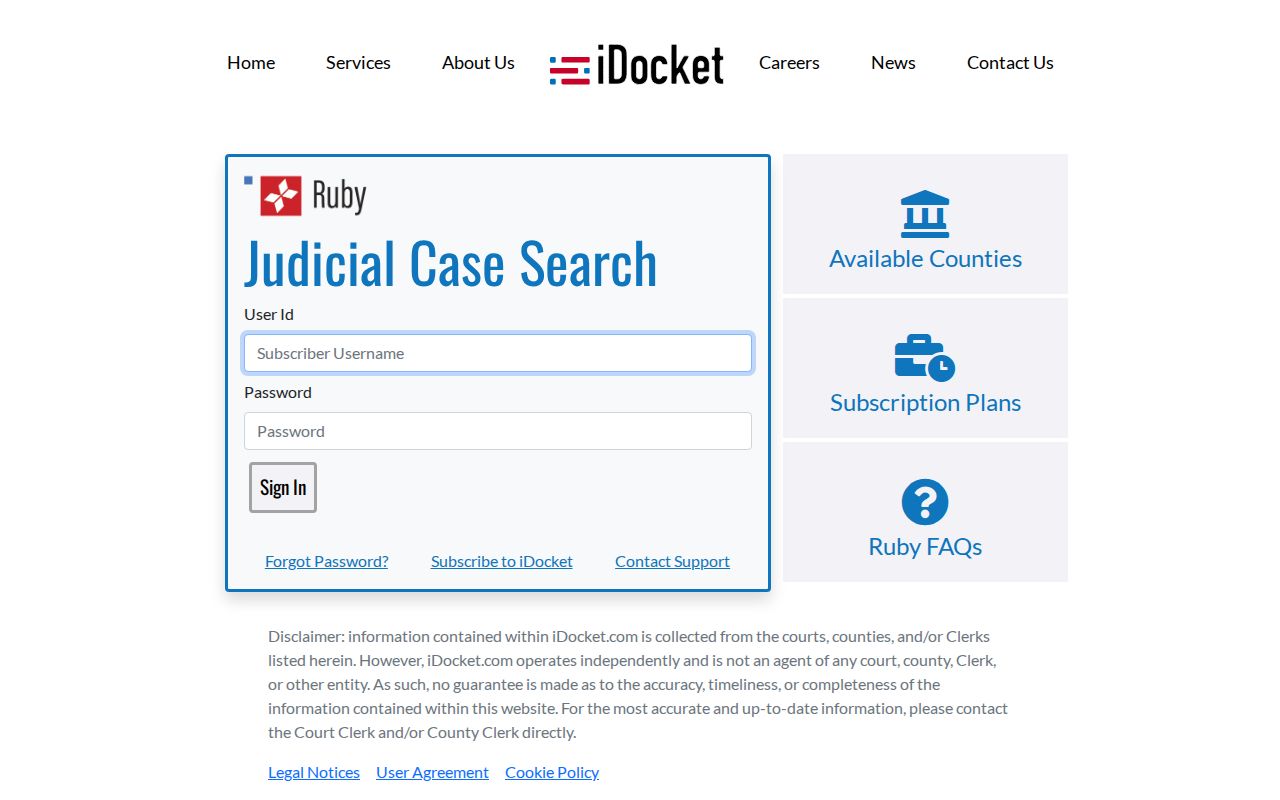
The screenshot makes clear that this is not an open, no-account city lookup. Use the clerk for pre-2003 files, missing images, a verified disposition, or a certified copy. Ask for the cause number, filing date, court, charging instrument, docket events, plea, judgment, sentence, and later orders. Those are reasonable request targets, not guaranteed interface fields.
Where Roaring Springs Records End Up
A reportable Roaring Springs arrest begins with an arresting agency. That office creates the incident and arrest narrative. The actual facility creates the booking and custody file. A prosecutor then chooses what to file, and the combined clerk preserves the resulting case. Fingerprints and tracking data go to the Texas Department of Public Safety, while a later court disposition returns to DPS to complete the arrest cycle.
Record flow: Roaring Springs incident › Motley County Sheriff or arresting agency › Motley County courts › Texas Department of Public Safety
This chain explains conflicting answers. The sheriff may know about a fresh Roaring Springs event that has no filed cause. The clerk may hold an old judgment for a person who is not in custody. DPS may show a public conviction or deferred adjudication but not the local officer narrative. The state's name search also depends on agency reporting and can over-match common names or miss a record. Fingerprints are the sound method for positive identity when reviewing your own Texas history.
Roaring Springs State Record Fallback
A Roaring Springs local search can widen to the Texas DPS Criminal History Conviction Name Search when the question concerns eligible statewide convictions and deferred adjudications. It is not a police-report, warrant, booking, or complete court-file search. Users create an account, prepay credits, and search with full first and last names. Middle or maiden name and birth-date details can narrow results. A no-match result still uses a credit.
The Texas Crime Records Division portal is the official statewide interface.
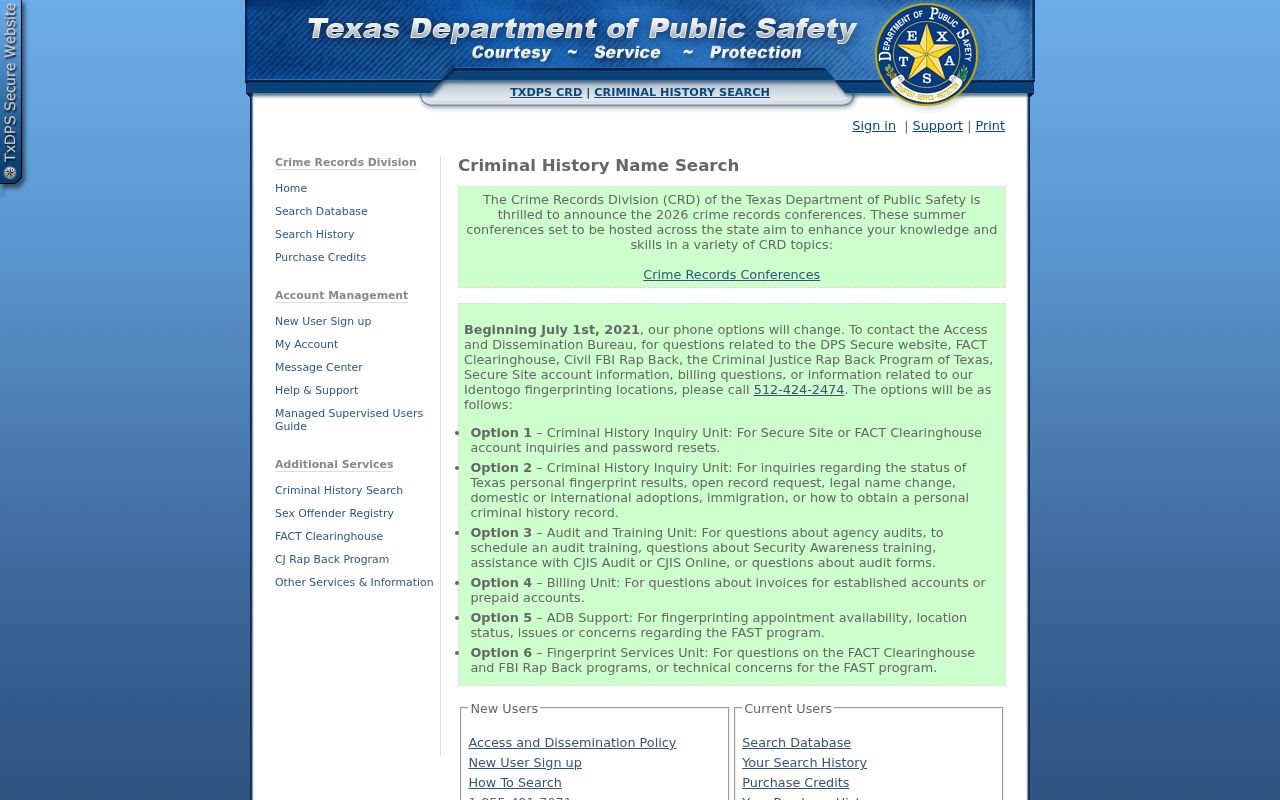
This state screen sits above Roaring Springs altitude and should be used for its narrow purpose. The public search currently costs one dollar per credit, with card-order charges, while an offline DPS name check is listed at ten dollars. For your own more complete Texas review, schedule FAST fingerprint collection through IdentoGO. No enrollment site was verified inside Motley County, so use the official locator rather than assuming a Roaring Springs appointment site.
Public Access Rules
Texas access law follows the record holder. A sheriff-created Roaring Springs incident or arrest report may be requested under the Texas Public Information Act. The agency may redact or withhold active-investigation material, juvenile information, victim data, and other confidential content. A filed adjudicative case belongs with the clerk and follows court-access law. Sending a PIA letter to an office that did not create or keep the record will not turn that office into its custodian.
Key Statutes:
Texas Government Code Chapter 552 provides access to governmental public information that is not excepted from release.
Texas Government Code Sections 411.083 and 411.135 restrict criminal-history information while authorizing eligible public conviction and deferred-adjudication access.
Texas Rule of Judicial Administration 12 guidance describes the distinct rules for judicial administrative records and court case files.
Code of Criminal Procedure Chapter 55A sets the routes for expunction of qualifying arrest records.
An accurate Roaring Springs request should state the desired record category, event date, place, involved agency, and any report or cause number. Nondisclosure restricts general public dissemination but preserves defined government access. Expunction is a different remedy and does not follow from dismissal alone. Eligibility depends on the arrest episode, charge outcomes, waiting rules, and statutory exclusions.
Roaring Springs Record Holder Split
Small-town scale does not merge the records. For Roaring Springs, the sheriff keeps locally created law-enforcement material and can identify the true holding facility. The justice court handles qualifying fine-only matters. The combined clerk keeps county and district case files. DPS keeps statewide fingerprint-linked criminal history. TDCJ covers sentenced state prisoners and parole, not a fresh Roaring Springs arrest. Each source should be read within those limits.
- Incident report
- The creating agency's account of the event, alleged conduct, place, officers, and evidence references.
- Booking record
- The actual holding facility's intake, charge, bond, custody, transfer, and release material.
- Disposition
- The court outcome, such as conviction, dismissal, acquittal, or deferred adjudication.
- Capias
- A court writ ordering arrest, often tied to a case or failure to comply with a court order.
Use the city name and event details to focus each request. Then compare the filed court outcome with the arrest record before drawing a conclusion. An arrest shows an allegation and custody event, not proof of guilt. If a DPS record is accurate but remains public, correction and clearing are different processes: correction fixes wrong or missing data, while expunction requires eligibility and a court order.